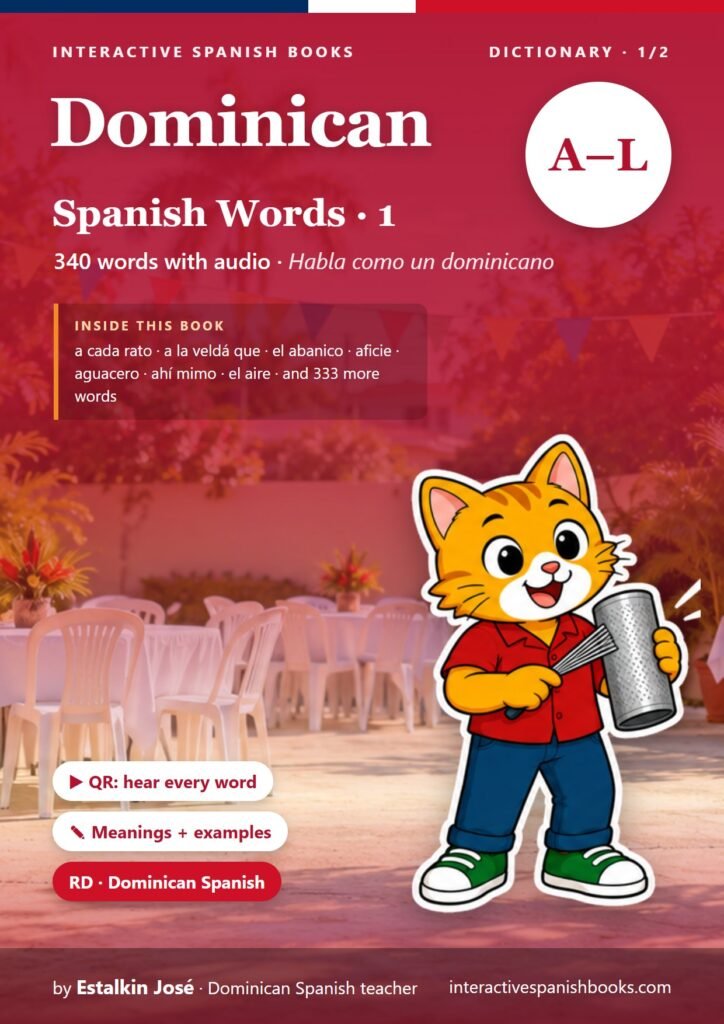
A–L · Habla como un dominicano
The Dominican words and phrases you will really hear (A to L), each with its meaning in English, the standard Spanish way to say it, real examples and a short explanation. Every word has a QR code to hear it said by a Dominican.
How it works: the online dictionary is free, with Dominican audio for every word. The PDF is for printing or for your tablet: every word has a QR code that opens its page with the audio and more examples.
Some of the words inside
- klk / ¿qué lo que? — what’s up?
The Dominican greeting. It comes from «¿qué lo que hay?» and gets written klk in texts. If you learn only one Dominican expression, make it this one. - colmado — corner store
Far more than a store: they let you run a tab, deliver by motorcycle, play music, and act as the social center of the neighborhood. A «colmadón» is one with tables that turns into a party on weekends. - guagua — bus
In the DR, Cuba, Puerto Rico and the Canary Islands this means bus. Careful: in Chile and Ecuador a guagua is a baby. - concho — shared route car
A car that runs a fixed route and picks up anyone who flags it down. Passengers keep squeezing in — six in a small car is normal. - dique — supposedly, allegedly
From «dice que» (they say that). It marks doubt or mockery about what is being told. Nothing to do with a dam. - bacano / vacano — awesome, cool
Spelled both ways. Works for things and for people. - cualto — money
The everyday word for money. Written «cuartos», said «cualto»: the r turns into an l and the final s goes quiet. One form for singular and plural. - jablador — liar, big talker
This is «hablador» said the Dominican way. Here it does not mean someone who talks a lot: it means someone who lies. - horita — later (not now!)
A trap! In Mexico «ahorita» means right now. Dominicans say «horita», dropping the first «a», and it means LATER — could be in an hour, could be tomorrow. For right now, say «ahora» or «ya». - dar una bola — give someone a ride
Asking for a bola is part of daily life. «Pedir bola» out on the road is hitchhiking. - bregar — to deal with, to handle
A key Caribbean verb. It means to deal with, to work, to sort out and to put up with, all at once. As a noun, «brega» is the daily grind. - apagón — blackout, power cut
An everyday word. «Se fue la luz» and «llegó la luz» are things you will hear daily. - inversor — power inverter
A battery that keeps the house running during blackouts. «¿Esa casa tiene inversor?» is a normal question when renting. - aguacero — downpour
Heavy, short rain. «Tremendo aguacero» is the normal way to say it — in the DR «tremendo» intensifies anything. - los tres golpes — salami, fried cheese and egg
The three classic sides for mangú. Ordering it like this in a comedor makes you sound local instantly.
Want to learn faster? Book a one-to-one class with José, a Spanish teacher from the Dominican Republic.